Pollinators in the Landscape

Animal and insect pollinators are an essential part of the productivity of flowering plants and food production, but have been in decline in recent years. This decline is largely due to pesticide use, as well as habitat fragmentation and climate change, which force pollinators to travel further distances and face harsh weather. These conditions leave animals stressed and at a disadvantage to find the plants they rely on.
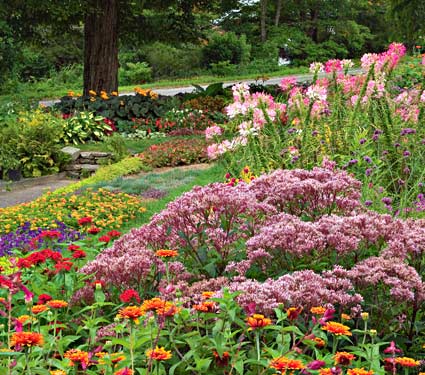
Image result for pollinator garden
Example of a pollinator habitat in Morris, CT
https://www.whiteflowerfarm.com/pollinator-garden

We are able to create new and improved habitats for pollinators through landscape architecture. This ecologically sustainable approach is more complex than it seems, with vegetation type, shelter sites, and safe location all needing to be kept in mind. An article written by Anthony Fettes highlights a few key concepts that should be utilized when creating pollinator-friendly landscapes, the first being to embrace the diversity that is inevitable when designing for multiple species. This includes have a wide range of florals, foraging sites, and taking into account how the changing seasons will effect the area, and how different pollinators will interact together. Site maintenance needs to be done with a different approach than typical landscapes, bringing awareness to how pruning effects these habitats, and avoiding pesticides at all costs, opting for more natural means of pest management. There are always opportunities for collaboration when building these types of landscapes, from universities, to botanical gardens, to ecological organizations. Landscape architects should always be looking to expand their knowledge and help to support the struggling diversity of pollinators.

Creating pollinator gardens is something that I would like to explore in my future career as a landscape architect. Since creating a plant palette is a large part of this, Fettes also discusses some key things to keep in mine when choosing vegetation. Designing to the native landscape is important, as well as trying to choose plants with long flowering periods. The different seasons need to be taken into account in order to provide a habitat for every time of year, and pesticides should be avoided as much as possible. With these tools in mind I feel confident in my ability to collaborate with others and create a sustainable space for pollinators that is also pleasing to the community. My goal is to educate rather than keep people away from these areas, and help to restore the pollinator community.

Incorporating Ecology into Urban Areas

Cities, towns, suburbs, and developed areas in general are becoming more and more prevalent throughout the world, and will continue to do so in the future. With this knowledge in mind, landscape architect must look towards designing with urban life in mind, rather than trying to create entirely separate systems.

Image result for urban ecology
Dubai’s largest public park
http://ecourbanhub.com/dubais-largest-public-park-urban-ecology-dubailand/

In order to practice urban ecology, past and present conditions must be looked at to better design for the future. This also entails looking at the relationship between natural and built environments, and their effects on one another. Urban areas inherently put restraints on the environment, such as what wildlife can grow and live there. Landscape architects need to work around and with these obstacles in order to create a coherent space that incorporates both elements equally.

Image result for yosemite visitor center
Yosemite National Park Visitor’s Center
https://openspaces.smugmug.com/Wild-places/John-Muir-Trail/i-8zkJXKD/

With regards to the Dangermond Preserve, the goal is to incorporate more human activity, which in turn means more built structures and spaces. The history walk I am creating is not exempt from this, as the trailhead is incorporated into the proposed welcome center. I plan on creating a path that connects the two spaces rather than separate them, so that visitors are drawn to the trail and see it as an extension of the center. Planting design will have a large role in this, as well as built structures such as signs, bridges, and entryways. I would also like to incorporate this practice into my future work, which is (hopefully) restoration projects. Restoration sites are often in urban areas, and should be reintroduced to the area as part of the network, not something that seems out of place.

Trends in Sustainable Design

I’ve recently read an article from ASLA’s PPN blog (The Evolving Practice of Ecological Landscape Design) that proved to be a very interesting introduction into what exactly ecological design is. Landscape architects are shifting the way they think about the spaces they design, many now looking towards green infrastructure to improve the environment and be cost effective. Rather than designing to a specific theme that may not apply to the area, they are looking at the ecosystem as a whole, and finding what fits best in the specific environment. By doing this the entire ecosystem can be supported, rather than just the vegetation.

Proposed green infrastructure project in Philadelphia
http://www.phillywatersheds.org/what_were_doing/green_infrastructure

The article also talks about SITES, which is a program that provides a set of guidelines for what a sustainable site should entail. It also includes a rating system for the ecosystem services of a site, and offers ways to improve their performance. A few of the principles stood out to me, specifically designing with nature and culture, using a systems thinking approach, and using a collaborative and ethical approach.

SITES Project at University of Texas
http://www.sustainablesites.org/dell-medical-district

I would like to integrate the principles mentioned above into my studio design. This quarter, I have decided to create a nature/historic walk on the Dangermond Preserve that focuses and the historical aspects of the site, from its origins with the Chumash to the current uses in the modern era. This will be done through incorporating a series of interpretive and interactive signs and structures that cater to all ages, and serve as a timeline throughout the path. The easiest principle to incorporate into my site will be designing with nature and culture in mind, which can be done simply by providing education on the history of the area. A systems thinking approach can be used by being careful not to disrupt the surrounding natural environment. If vegetation needs to be added or removed, it needs to be justified and ensured to not displace the current ecosystem. The same goes for adding structures, grading, and human activity. I will design ethically and in a collaborative way by conferring with my classmates, many of whom are creating educational programs for visitors of all ages. My design can be incorporated into their projects as part of the itinerary for visiting tour groups.

History walk at the Arenal Volcano in Costa Rica
https://www.arenal.net/tours/natural-history-walk-hanging-bridges

Designing ecologically can be confusing, as the needs of the environment are never stagnant. I have found the SITES can be used as a good resource for general guidelines of what to keep in mind when creating a site, and creating a space that will be ecologically beneficial to both nature and human activity. I hope to keep these principles in mind in my future projects, and continue to design ecologically sustainable areas.

Why Landscape Ecology?

Welcome to my blog! A little bit about me, my name is Shelby Adams, and I am currently a 4th year landscape architecture student at Cal Poly SLO. I absolutely love anything and everything outdoors, from hikes, to concerts, to picnics.

Cliffside view of the Dangermond Reserve
https://www.landreport.com/2018/06/land-report-2017-deal-of-the-year-the-dangermond-preserve/

This blog will focus largely on landscape ecology and restoration; a topic that I am thoroughly interested in. I chose to join this network because I believe that it is the direction that landscape architecture as a whole should move towards, and I want to become more educated on the subject so that I will be able to integrate the principles into my future practice. I am currently enrolled in LA 403, the natural environments studio course. Our site for the quarter is the Dangermond Reserve, located in Santa Barbara County. Professor Bass is allowing us to individually choose what we would like each of our project focuses to be, and I would like to apply landscape ecology and restoration to the site, possibly through partial site restoration and the creation of a historic learning center.

Between these two classes, LA 435 and LA 403, the learning opportunities are endless. I am excited to see what this quarter has in store for me, and hope that I will grow more into the landscape architect I aspire to be.